The Velocity Gap: Why Your Organization Is Already Behind the Next Generation
Walking the halls of Duke during a hackathon, the future hadn't just arrived — it had unpacked its bags. AI isn't a specialty tool for the next generation. It's the baseline. And companies that don't adapt will lose them.
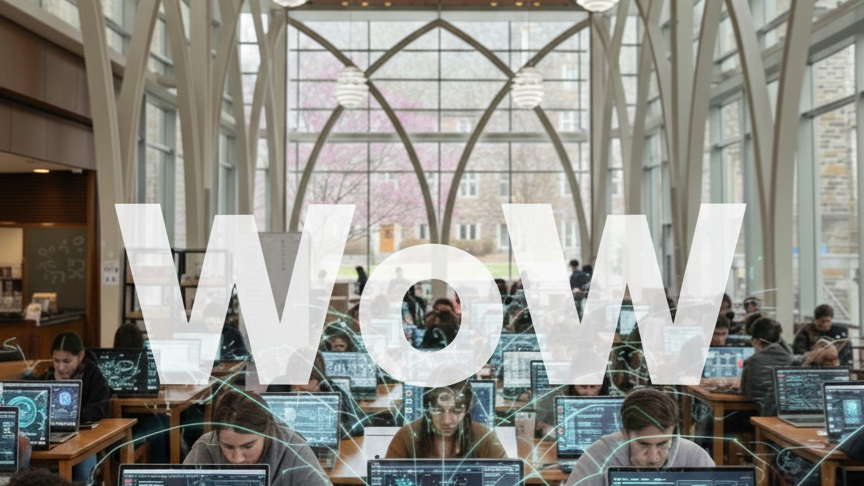
Walking through the halls of Duke University during a hackathon this past weekend, the future didn't just feel close — it felt like it had already moved in, unpacked its bags, and started rewriting the syllabus.
While the engineering labs were humming with the expected high-level AI integration, the real revelation happened in the "in-between" spaces. In the Brodhead Center food hall and the quiet corners of Perkins Library, a quick glance at student screens revealed a universal truth: AI is no longer a "specialty" tool. It is the baseline.
From freshman essays to complex data modeling, every student I saw was leveraging AI. For this incoming generation, these tools aren't a novelty to be "tested" — they are as fundamental as the internet was to Gen X, with one terrifying difference: velocity.
The Johnson Zhu Litmus Test
In the food hall, I met a student named Johnson Zhu. I asked him a pointed question:
"Given that most of the other cultural and salary components were the same, would you solely base your decision to work somewhere on them embracing or being hesitant to allow the use of AI?"
He didn't need to ponder it. He thought for a single second and answered confidently:
"Absolutely. The hesitation to enable and embrace something so fundamental would tell me that their capacity to execute quickly in a fast-paced world would put me at a disadvantage. Not being able to adapt dynamically is catastrophic."
Johnson isn't an outlier; he is the new standard. We both agreed on a core truth: Humans will not be replaced by AI. However, companies that don't adopt AI will be replaced by those that do — and employees at stagnant companies will absolutely be replaced by those who are AI-fluent.
The New Meritocracy: Tools Over Pedigree
In the 90s, the internet took a decade to move from academic curiosity to corporate necessity. AI has bypassed that waiting room entirely. It is already the primary academic engine for the talent you are trying to recruit.
The traditional "cultural fit" model — where a hire is judged on their ability to adapt to your legacy systems — is dead. To attract the thinkers of the next age, the burden of adaptation has shifted. Organizations must now prove they are a fit for the tools the students are bringing with them.
Why High Salaries Won't Save You
You can offer a massive signing bonus, but if you drop a "Formula 1" student into a "horse and buggy" workflow, they won't stay. The winners of the next decade won't be the companies with the deepest pockets; they will be the ones who create an accelerant space.
- The College Exit Velocity: These students are graduating with a momentum most corporations aren't built to handle. They are used to moving from "idea" to "prototype" in hours, not months.
- The Friction Problem: If your internal security protocols, outdated tech stacks, or "wait-and-see" leadership act as a brake on their ability to deliver, they will leave.
- The "Testing" Trap: While corporations are "testing" AI in pilot programs, the talent is already "living" in it. If you are still in the pilot phase, you are already behind.
The Choice: Adoption or Atrophy
The message from the Duke campus was clear: the next generation of thinkers is not waiting for permission. They are entering the workforce with a whole new cognitive architecture.
The Warning: If your organization acts as a brake on a hire's ability to execute because you aren't comfortable with the speed of AI, your decline will be swift.
You cannot recruit the best and then ask them to work at 20% of their capacity because your infrastructure is stuck in 2019. To win, you must build an environment that doesn't just "allow" AI, but demands it. You need to provide a runway that matches their takeoff speed.
Mandatory Company Pivot
At BankSocial®, we didn't just see this shift coming; we leaned into it. In mid-2024, I instituted a formal mandate: AI would not just be allowed — it would be encouraged across every single aspect of our business. I personally created workflows. We created end-of-week demos where we encouraged team members to innovate, fail, and demo. The results haven't just been positive — they've been transformative.
Performance has increased exponentially across the board. Crucially, we haven't fired a single person, nor have we pivoted our core strategy on the what, why, or how of our builds. Humans remain intimately involved at every level of our creative and technical processes; they are simply now empowered to move and output at a velocity that was previously impossible.
We aren't replacing our people. We are uncapping their potential.
Want to talk about this with me?