To Stablecoin, or Not to Stablecoin, That is the Question
Why spend 10 BPS to mint a digital dollar when you can send a sovereign one for less than the price of a stick of gum? The era of stablecoin maximalism is ending. The era of Autonomous Alchemy has begun.
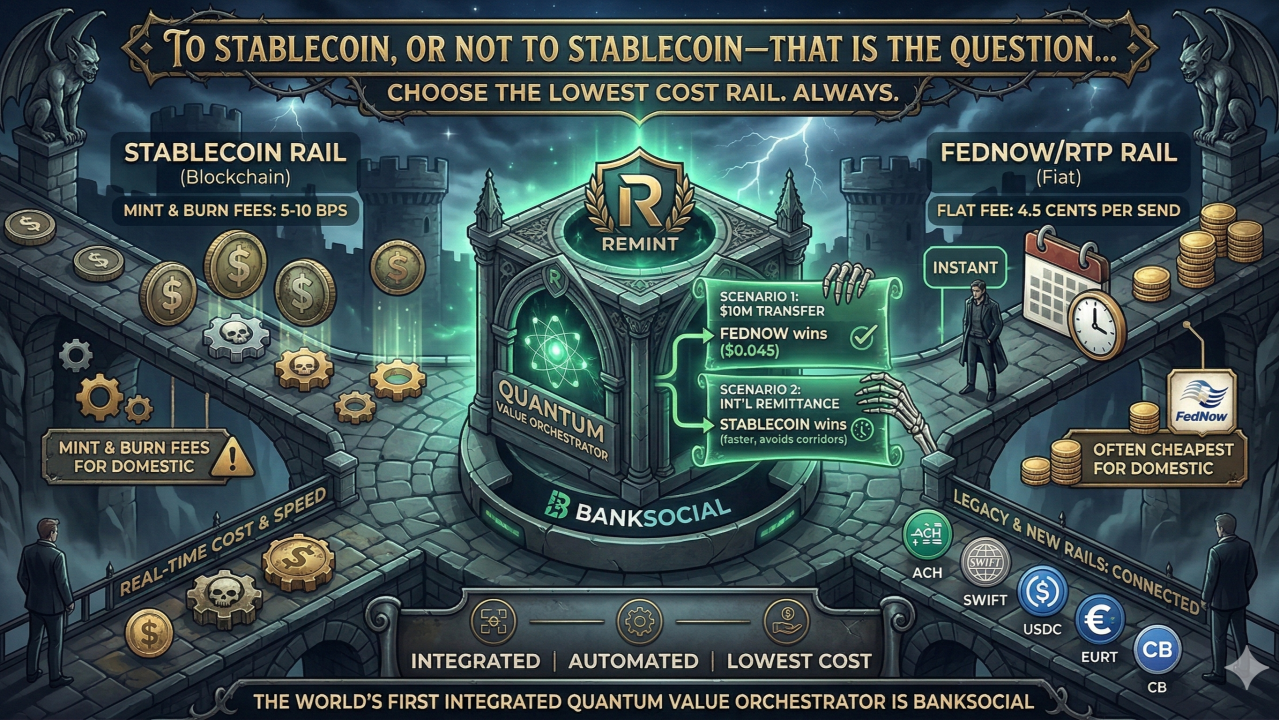
"Whether 'tis nobler in the mind to suffer the slings and arrows of outrageous minting fees, or to take arms against a sea of gas costs, and by opposing, end them?"
For years, the crypto-evangelist's soliloquy has been simple: "The old rails are dead; the blockchain is the way." But as we navigate the financial waters of 2026, the tragedy of the "one-size-fits-all" payment strategy has become clear. The reality of modern finance is not a monologue — it is a complex, multi-act play where the "cheapest" rail is a moving target, and the hero isn't a single currency, but the Quantum Value Orchestrator behind the curtain.
Act I: The Hidden Cost of the "Stable" Path
We were told stablecoins would democratize value, and in many ways, they have. But "free" they are not. To enter the stablecoin realm, one must mint; to exit, one must burn. In the institutional world, these operations often carry costs of 5 to 10 basis points (BPS).
While a fraction of a percent sounds like a "trifle," in the world of high-volume treasury, it is a "dagger which I see before me." If you are moving $10 million, a 10 BPS mint fee is $10,000. Suddenly, the "slow" legacy system doesn't look so villainous.
Act II: The Rise of the "Old Guard"
While the crypto world was building its citadels, the Fed was sharpening its own blades. The FedNow® Service and RTP (Real-Time Payments) have changed the physics of the "lowest cost rail."
- FedNow: A flat $0.045 (4.5 cents) per credit transfer.
- The Sweetener: The Fed currently waives fees on the first 2,500 transactions per month.
- The Threat: If the Fed decides to lower these costs further to drive adoption, the math for stablecoins falls apart for domestic transfers.
Why spend 10 BPS to mint a digital dollar when you can send a sovereign one for less than the price of a stick of gum?
Act III: Enter Agentic Payments and x402
If stablecoins and FedNow are the roads, Agentic Payments are the self-driving vehicles. We have moved toward a machine-to-machine economy where your AI agent — your "digital proxy" — manages your financial life without you needing to approve every 4.5-cent toll.
This is where the ghost in the machine awakens: x402. For 30 years, the internet had a "Payment Required" error code (HTTP 402) that sat dormant. Today, it is the native language of the web. When an AI agent hits a paywall or an API, the server returns an x402 header. Instead of a human manually typing in a credit card, the system recognizes the request, calculates the cost, and settles it instantly direct from digital banking.
Act IV: The Quantum Value Orchestrator
If the lowest cost rail is a shifting tide, how does a financial institution stay afloat? You cannot simply "pick a side." To do so is to be Hamlet — frozen in indecision while profit margins bleed out.
The industry has moved beyond simple "gateways." The new requirement is the Quantum Value Orchestrator: a system capable of analyzing every available rail (FedNow, RTP, Stablecoin, SWIFT, ACH) in real-time and routing value through the one that is mathematically the most efficient at that exact microsecond.
BankSocial® has delivered the world's first integrated Quantum Value Orchestrator through its Remint™ layer.
By connecting directly to the bank's core and bridging to both legacy and emerging rails, BankSocial does what no individual rail can do alone: It chooses.
Conclusion: Parting is Such Sweet Sorrow
The era of "Stablecoin Maximalism" is ending, replaced by the era of Autonomous Alchemy. There is no "perfect" rail — only the perfect choice for a specific moment.
As the Fed continues to squeeze the cost of domestic transfers and stablecoin issuers fight to keep their mint/burn fees competitive, the winners won't be those who chose a single path. The winners will be those who, like Prospero, command all the elements.
The question is no longer "to stablecoin or not." The answer is: Use BankSocial, and do both — whenever it costs you the least.
Want to talk about this with me?