The Scratchpad Effect: Why Telling Your AI to "Take Its Time" Actually Works
Adding "take a deep breath" or "think step-by-step" to your AI prompts isn't cargo-cult mysticism — it's architecture. Every token an LLM outputs is a unit of compute, so giving the model scratch paper lets it actually think.
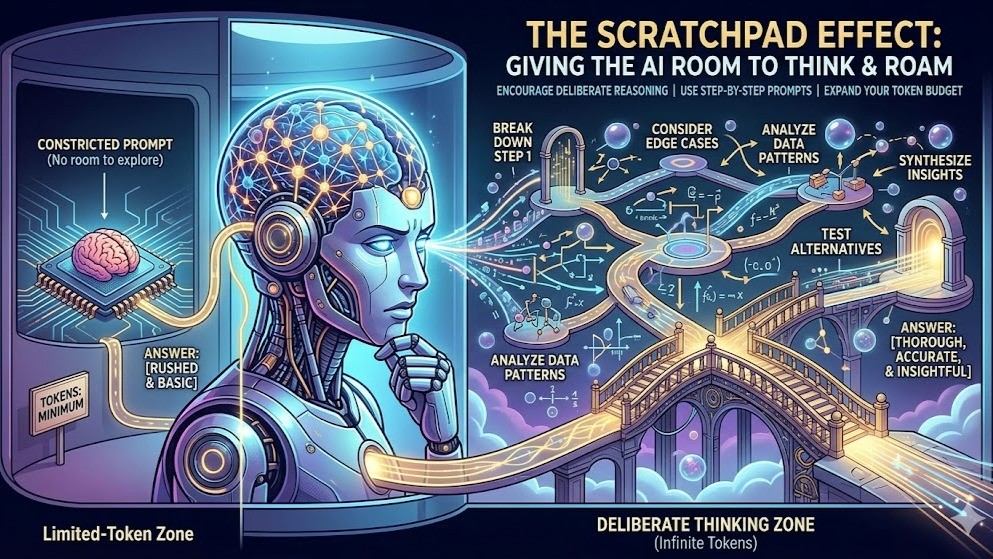
If you follow the world of prompt engineering, you've likely seen people adding phrases like "Take a deep breath," "Think step-by-step," or "Use as many tokens as you need" to their AI prompts.
At first glance, this sounds like cargo-cult AI mysticism. Algorithms don't breathe, they don't have clocks to watch, and they don't get anxious. So why does telling an AI to "take its time" or "use more tokens" consistently yield vastly superior, more accurate results on complex tasks?
Once again, the answer isn't psychological — it's entirely architectural. When you tell a Large Language Model (LLM) to slow down, you aren't changing its attitude; you are changing its computational budget.
Here is how the "Scratchpad Effect" works under the hood and how to use it to unlock deeper reasoning from your models.
Tokens Are Compute, and Compute Is Thinking
To understand why encouraging an AI to use more tokens matters, you have to understand how a transformer "thinks."
An LLM does all of its heavy mathematical lifting during the generation of each individual token. It looks at the prompt, runs it through its neural layers, and outputs one word (or part of a word). Then, it takes that new word, appends it to the prompt, and does the exact same amount of math to calculate the next word.
This creates a rigid limitation: The model can only perform a fixed amount of computation per token.
Imagine asking a human mathematician to solve a complex, multi-variable calculus problem, but with a catch: they are only allowed to speak the final answer out loud, with absolutely no scratch paper allowed. If they can't compute the entire chain of logic in their head in a single split second, they will guess.
When you give an AI a massive, intricate task and ask for a short, immediate answer, you are forcing it to do mental math without scratch paper. It has to cram a 10-step reasoning process into the generation of a single final output token. Usually, it fails.
Turning Text Into Working Memory
When you explicitly instruct an AI to "take its time and break down the problem step-by-step," you are handing it a piece of scratch paper.
By telling the model to output its intermediate reasoning steps before arriving at a final conclusion, you trigger a powerful mechanism known as Chain-of-Thought (CoT) processing.
Here is what happens mathematically:
- The AI outputs Step 1 of the logic.
- That outputted text is fed back into the transformer's context window as part of the prompt history.
- When the AI goes to calculate Step 2, it can now literally "see" its own previous logic.
Every token the model outputs becomes a physical anchor in its working memory. By encouraging the AI to use more tokens, you are giving it the space to build a bridge of logic, token by token, rather than forcing it to leap across a canyon in a single bound.
The Practical Prompting Shift
If you want an AI to perform deep analysis, code reviews, or complex strategic planning, you have to design prompts that explicitly expand its token budget.
Look at the difference between a constrained prompt and an expanded reasoning prompt:
The Constrained Prompt (Low-Token Trap):
"Analyze our Q1 marketing data and tell me the single biggest reason our conversion rate dropped. Keep it brief."
The result: the model is forced to guess a conclusion immediately based on superficial patterns, often missing underlying variables.
The Expanded Prompt (The Scratchpad Unlock):
"Analyze our Q1 marketing data. Take your time and use as many tokens as necessary to break this down. First, map out the traffic sources; second, highlight anomalies in the funnel stages; third, debate three potential root causes. Only after showing your step-by-step work should you provide a final conclusion."
The result: the AI uses its initial output tokens to dig into the data, cross-reference its own observations, and naturally arrive at a highly accurate, nuanced conclusion.
How to Bake This Into Your Workflows
To get the highest quality outputs from modern models, use these three rules of thumb to encourage "deliberate thinking":
- Ban brevity for complex tasks. If a task requires logic, math, or deep synthesis, never use words like "be concise" or "summarize quickly." Give the AI permission to be verbose.
- Force a reasoning stage. Explicitly instruct the model to separate its thinking from its final answer. Use phrases like: "Show your scratchpad thoughts in a markdown block before writing the final code."
- Embrace the token spend. Yes, more tokens cost slightly more API fractions or take a few more seconds to generate. But a cheap, fast, incorrect answer is always more expensive than a slow, thorough, correct one.
When we interact with AI, space equals intelligence. By encouraging your models to use more tokens and take the long way around a problem, you aren't just being patient — you are giving the transformer the computational room it needs to excel.
Want to talk about this with me?