Orchestration vs. Obsolescence: Lessons from the BCB 561 Ruling
If your strategy for Brazil was "Stablecoins or Bust," you have officially hit Bust. The future of finance isn't about the coin — it's about the coordination.
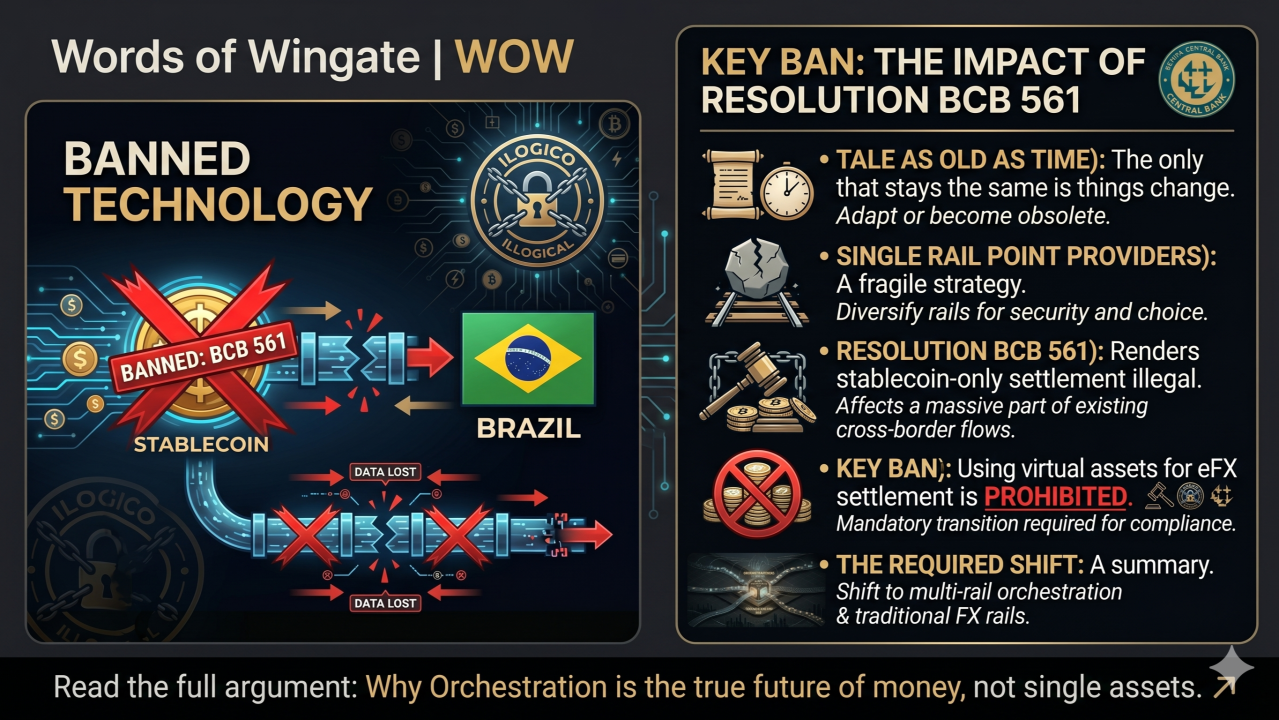
The Single-Rail Trap
Why BCB 561 Just Proved "The Future of Finance" Article Right
A few months ago, I published a piece titled "The Future of Finance Is Not Stablecoins". In that article, I highlighted a recurring cycle in our industry: the desperate search for a "savior." We saw it with the initial hype of digital wallets, then with the explosion of embedded finance. Most recently, the industry pinned its hopes on stablecoins as the definitive, "unblockable" architecture for global value transfer.
In that piece, I featured a visual of the Orchestrator Hub — a philosophy of governed coordination rather than asset-class loyalty. I argued that the market's obsession with a single "silver bullet" rail was a dangerous oversight.
Well, it looks like I hit the nail on the head. For anyone operating in the corridor between Brazil and the rest of the world, that oversight just became an existential crisis.
The Tale as Old as Time: Change is the Only Constant
They say history doesn't repeat itself, but it often rhymes. In the world of fintech and cross-border movement, the "tale as old as time" is the assumption that a technological loophole will remain open forever. We fall in love with the efficiency of a new rail and forget that the rails are laid across land owned by sovereign regulators.
If you were moving money, or planning to move money, using stablecoins as your primary settlement rail for international transfers with Brazil, the music has officially stopped.
Resolution BCB 561 has arrived, and it carries the weight of a final verdict. The Banco Central do Brasil (BCB) has explicitly rendered the use of "virtual assets" (crypto/stablecoins) illegal for the settlement of regulated eFX international payments. In their view, the "stablecoin shortcut" isn't a modern innovation; it's a bypass of the regulatory frameworks designed to protect monetary sovereignty and prevent money laundering.
The Great Brazil Pivot
The BCB isn't just making a suggestion. They have mandated that settlements between eFX providers in Brazil and their counterparts abroad must now occur through two specific, highly regulated avenues:
- Direct Foreign Exchange Transactions — The traditional, regulated FX market.
- Non-resident BRL Accounts — Utilizing the local currency through authorized channels.
For the "stablecoin-only" crowd, this isn't just a hurdle; it's a brick wall. If your entire value proposition was built on the speed and cost-savings of a stablecoin rail to bypass the "clunkiness" of the Brazilian central bank's reporting requirements, your business model in this corridor has just been rendered obsolete by a single signature.
Why the "Single-Rail" Strategy Was Always Flawed
This is the "I told you so" moment I warned about in my last article. When you build your house on a single rail — especially one that exists in a regulatory gray area — you are essentially gambling on the silence of central banks.
In the visual I shared previously, I showed that Orchestration is the Future of Money. Why? Because orchestration acknowledges that the world is messy, political, and volatile. A single-rail provider is rigid. They are a one-trick pony in a circus that keeps changing the acts.
When you rely on a single rail, you are fragile. When you rely on an Orchestrator Hub, you are antifragile. If the BCB shuts down the stablecoin route today, an orchestrator doesn't panic. They simply reroute the flow through a non-resident BRL account or a regulated FX rail. The client never sees the friction; the value keeps moving.
Compliance as a Competitive Advantage
Many in the crypto space view regulation as the enemy of innovation. At BankSocial, we see it differently. Regulation is the framework of the reality we live in. True innovation isn't finding a way to sneak past the regulator; it's building infrastructure so robust and flexible that it can thrive within any regulatory environment.
BCB 561 is a reminder that the "gray area" is a temporary luxury. Eventually, the gray turns to black or white. By moving the goalposts, the BCB has effectively cleared the field of the "cowboys" and left the market to those who understand the necessity of governed, multi-rail coordination.
The Bottom Line: Adapt or Evaporate
If your strategy for Brazil was "Stablecoins or Bust," you have officially hit "Bust."
The "Words of Wingate" for today are a call to action: Stop hunting for saviors and start building for resilience. The future belongs to the orchestrators — the ones who aren't married to a specific token or a specific technology, but are instead committed to the seamless, compliant movement of value across any border, under any ruleset.
We predicted this shift because we understood that the "Future of Finance" isn't about the coin; it's about the coordination. If you're still looking for a single-rail savior, you're not just behind the curve — you're off the tracks.
Want to talk about this with me?