Mirror in the Machine: Why AI is Only as Smart as You Are
AI doesn't possess a secret wellspring of genius. It's a cognitive mirror — a reflection of human curiosity, data, and direction. The bottleneck isn't computing power. It's the imagination of the person asking.
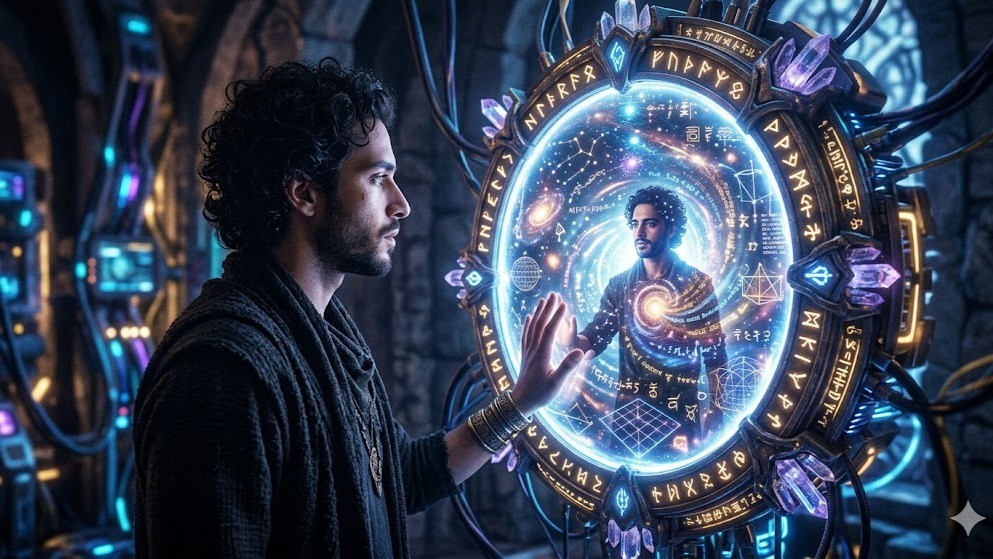
For decades, science fiction has primed us to expect Artificial Intelligence to arrive like an alien deity. An independent, looming intellect that descends with all the answers to humanity's greatest mysteries. We wait for the machine to flash a loading icon and suddenly deliver the unified theory of physics or the cure for aging.
But this expectation misses a fundamental truth about the nature of synthesis. AI does not possess a secret, autonomous wellspring of genius. Instead, it operates as a cognitive mirror. It is a hyper-advanced reflection of human curiosity, data, and direction. Ultimately, an AI is only ever as smart as the person prompting it, because the true engine of discovery isn't just calculating data, it is the cross-disciplinary imagination required to ask the right question.
The Illusion of Autonomous Genius
When people interact with large language models, it is easy to fall into the trap of thinking the machine is "thinking" the way we do. In reality, AI excels at statistical pattern recognition on a massive scale. It can read millions of medical journals, legal briefs, and engineering papers in seconds, mapping the semantic relationships between words and concepts.
However, knowledge is not the same as understanding, and data is not the same as insight. Left to its own devices, an AI is a library with the lights off. It contains the sum of human knowledge, but it cannot wander the aisles choosing what to read, nor can it invent a completely new discipline out of thin air. It requires a human agent to turn on the lights, point to two seemingly unrelated shelves, and say, "Connect these."
Parallel Thinking and the Multi-Discipline Matrix
The prompt "stop waiting for the answer and start searching across a multitude of disciplines" perfectly captures the modern AI paradigm. The greatest breakthroughs in human history rarely happen in a vacuum; they happen at the intersections of different fields. Biology meets computer science to create bioinformatics. Behavioral economics bridges the gap between psychology and finance.
AI is uniquely built to accelerate this cross-pollination, but it requires a human architect to map the trajectory. Because AI can process vast amounts of disparate information simultaneously, it allows a user to engage in parallel thinking. You no longer have to spend twenty years mastering organic chemistry and another twenty mastering fluid dynamics to see how they might intersect. You can use AI as a cognitive bridge.
[Human Intuition & Intent] → [AI Cross-Disciplinary Synthesis] (Biology, Physics, Ethics, etc.) → [Breakthrough Insight]
But the AI will not spontaneously decide to merge medieval poetry with modern game theory to analyze social media algorithms. That bizarre, brilliant leap of intuition belongs entirely to the human mind. If a user approaches an AI with shallow, single-variable questions, they will receive shallow, predictable answers. If a user approaches it with a multi-disciplinary, boundary-pushing mindset, the AI will mirror that sophistication back to them.
This shift from linear problem-solving to multi-dimensional synthesis is what I explore in my book, Quantularity, through a concept called the quantuality layer. Think of it as an unlimited, hyper-fluid experience layer where tasks don't just run one after another, but in vast, simultaneous clusters. It transforms how we interface with machine intelligence. Instead of waiting for a single prompt to compute, the human mind uses the quantuality layer to orchestrate an entire symphony of operations at once, fundamentally altering our cognitive bandwidth.
Elevating the Prompt from Command to Collaboration
To unlock the "genius" of AI, we have to stop treating it like a search engine and start treating it like a collaborative canvas. When you ask a traditional search engine a question, you are looking for a pre-existing static answer. When you collaborate with AI, you should be looking to generate something new.
Within this framework, collaboration ceases to be a static conversation and becomes a dynamic navigation of realities. Achieving true Quantularity means having the ability to seamlessly jump in and out of parallel processes as they unfold. You can initiate a creative task, split it into five different analytical iterations across five different disciplines, and actively leap between these parallel streams to adjust variables in real-time. You aren't just directing a tool; you are stepping into an experiential sandbox where multiple potential outcomes are being forged simultaneously. It is the cognitive equivalent of quantum superposition, where every parallel process exists in a state of pure possibility until your attention shifts to it, collapsing a multitude of potential realities into a single, definitive breakthrough.
This shifts the responsibility of intelligence back onto us. To get a genius response, you must craft a genius prompt. This requires:
- Deep Contextualization: Providing the AI with specific constraints, personas, and underlying philosophies.
- Forced Intersections: Explicitly commanding the AI to view a problem through the lens of an entirely different field (e.g., "Analyze this supply chain problem using the principles of evolutionary biology").
- Iterative Refinement: Treating the initial output not as a final answer, but as raw material to be questioned, dismantled, and rebuilt.
When you push the boundaries of your own curiosity, the AI expands with you. It acts as an amplifier of your intellectual capacity. If you are intellectually lazy, the AI will happily generate lazy copy. If you are rigorous, creative, and relentless, the AI will synthesize connections that feel downright miraculous.
The Frontier of Human Potential
We are entering an era where the bottleneck to solving global challenges is no longer the retention of information or the speed of calculation; the bottleneck is human imagination.
AI is as smart as we allow it to be because its outputs are strictly bounded by the parameters of our inquiries. It is waiting on us. The machine is ready to search across a multitude of disciplines in parallel, to map the stars against historical linguistics, or to screen molecules using architectural principles. It possesses the raw processing power to reshape our world, but human curiosity remains the spark that ignites the engine.
Ultimately, the realization of AI's true genius relies on our ability to inhabit this state of Quantularity. When we stop viewing technology as a linear calculator and start utilizing it as an unlimited experience layer, we collapse the distance between thought and execution. By mastering the art of jumping between these parallel intellectual realities, we don't just find answers faster — we expand the very boundaries of what is possible.
Stop waiting for the machine to give you the answer. Ask it a better question.
Want to talk about this with me?