The Great Deposit Heist: Stablecoins, the Ghost of Cronie
The market is selling community banks a deceptively simple future: move the money to the token. But the "Yield Mirage" is hollowing out local institutions — and finance doesn't need more yield. It needs less waste.
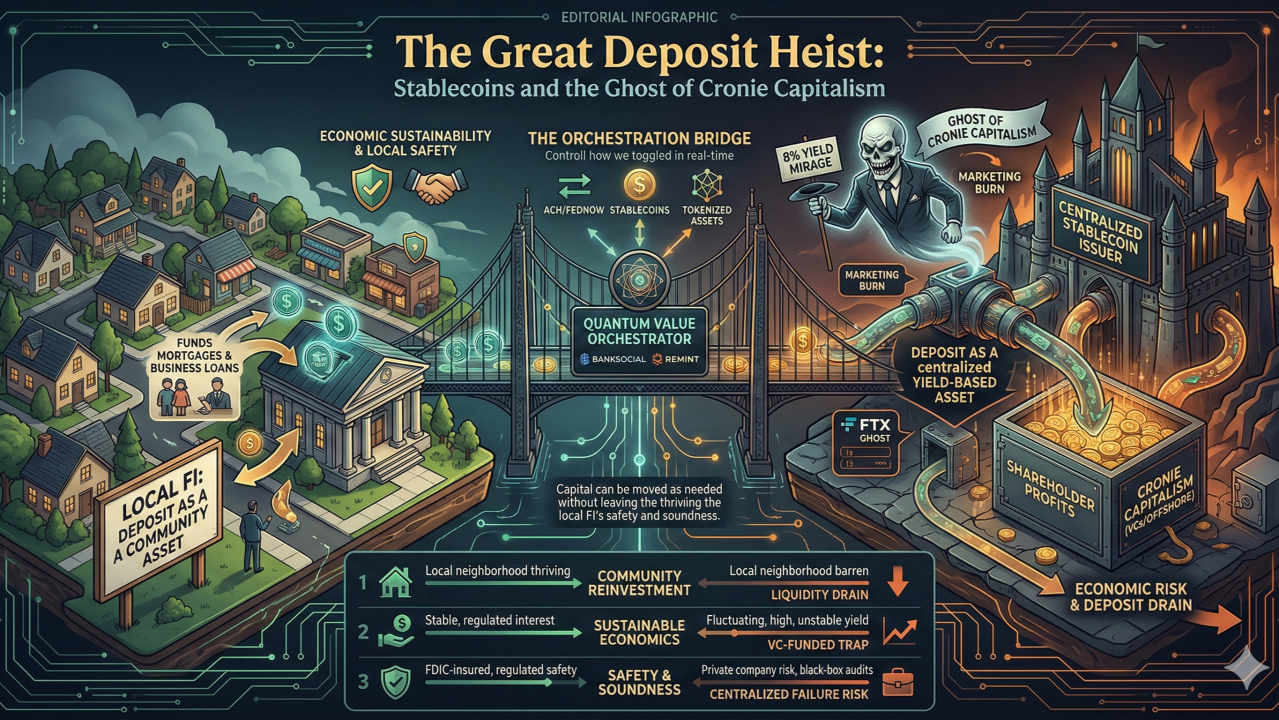
Why the "Yield Mirage" is hollowing out local financial institutions, and how to deliver modern speed without surrendering deposits.
It's a provocative title because it hits the heart of the modern financial struggle: the tension between technological speed and community stability.
Right now, the market is trying to sell local banks and credit unions a deceptively simple future: move the money to the token. But in many of the most aggressively marketed stablecoin models, that "future" is really a rerun of an old story — rent-seeking dressed up as decentralization.
This isn't "banks vs. crypto." It's community balance sheets vs. shareholder extraction. If we want to make this a definitive thought, we need to name the mechanism: the Yield Mirage — and explain why the only sustainable path is speed through rails, not surrender through balance-sheet migration.
The Myth of the "Stable" Deposit
A payment stablecoin was never meant to replace a deposit account. A deposit at a community-owned FI isn't just a number in an app — it's a productive asset that powers the real economy. Deposits fund mortgages, small business credit, community liquidity, and local resilience across cycles.
When deposits migrate off the balance sheet of community institutions and onto the balance sheet of centralized issuers, something fundamental changes. The capital is no longer tied to a local credit engine. It's pooled, warehoused, and optimized for issuer economics. Your community didn't get a faster financial system — it got intermediated.
That's the first sleight of hand: "stable" becomes a wrapper around a new business model, not a better community financial instrument. And once enough deposits leave the local FI, the institution doesn't just lose funding — it loses relevance. It becomes a thin front-end while the real liquidity power consolidates elsewhere.
The Yield Mirage: How Deposits Get Vacuumed Out of the Community
To understand the deposit drain, don't start with the technology. Start with incentives.
The most effective extraction weapon isn't the stablecoin itself. It's subsidized yield.
When an issuer (or platform) offers a shiny yield number — especially one that isn't clearly tied to sustainable unit economics — it creates a gravitational pull. Consumers don't see balance-sheet migration; they see 8%. They see "better than my checking account." They see an easy story: my money earns more over there.
But "yield" can be manufactured:
- incentives and marketing subsidies that won't last
- rewards that depend on growth, not sustainability
- treasury carry captured by the issuer and redistributed selectively
- "yield" functioning as customer acquisition cost
The result is predictable:
- deposits exit local regulated institutions
- liquidity concentrates in centralized pools
- lending capacity and community margin get squeezed
- the market gets louder, not safer
- when incentives drop, trust breaks — and fast
This isn't innovation. It's a balance-sheet land grab powered by a number on a screen.
Finance Doesn't Need More Yield. It Needs Less Waste.
Here's the pivot the industry refuses to make: the future of finance isn't higher yield. That's the trap. The future is lower cost.
Higher and higher yields are often lipstick on inefficiency — subsidies, marketing, and balance-sheet extraction dressed up as progress. It distracts from the real problem: we've built a system that leaks money through friction, fraud, and overhead… then we try to paper over it with yield.
A healthy system doesn't win by out-yielding reality. It wins by deleting waste:
- make borrowing cheaper (lower cost of funds, faster settlement, better underwriting loops)
- make payments cheaper (optimal routing, fewer intermediaries, fewer fees)
- make fraud harder (real-time intelligence, verification, controls that actually work)
- make operations lighter (automation, fewer exceptions, less manual triage)
- keep deposits productive inside communities (so capital funds real households and businesses)
Stop selling yield. Start deleting waste.
That's real modernization — because it compounds. Lower fraud means lower losses. Lower friction means lower fees. Better controls mean fewer disputes. Lower costs mean better member outcomes without inventing unsustainable yield promises.
The Ghost of FTX: Yield as a Weapon, Not a Feature
If you want to see how dangerous the Yield Mirage becomes, remember what "yield" turns into during hype cycles: a weaponized growth strategy.
In that environment, the winner is rarely the most sustainable model. The winner is the one who markets the hardest, subsidizes the fastest, and turns liquidity into narrative. Safety and soundness doesn't win headlines. Yield does.
And when subsidized yield becomes the funnel that vacuum-pulls deposits out of community institutions, the damage doesn't show up immediately. It shows up later — as thinner margins, fewer loans, reduced resilience, and a local FI that's been hollowed out, right when the cycle turns and the community needs it most.
When incentives fade, the music stops. The issuer keeps the scale. The community is left with less capacity than before.
Sustainable Economics vs. Shareholder Extraction
Local banks and credit unions aren't perfect, but their mandate is structurally different. They exist to serve communities, not to maximize extraction. That advantage only matters if they can deliver modern speed without surrendering the balance sheet.
This is the line in the sand:
We need a network of regulated, community-owned institutions that can participate in stable-value and real-time rails without becoming liquidity donors to centralized issuers.
That requires separating two things the market keeps trying to fuse:
- The rail: how money moves (speed, reach, interoperability)
- The asset: where value lives (deposits, safety and soundness, community credit capacity)
If the only way to get speed is to move value onto someone else's balance sheet, you've already lost. You traded your community's balance sheet for somebody else's growth story.
The Real Answer: Multi-Rail Access With Policy-Based Control
The future is not "stablecoin everything." It's multi-rail money movement with institution-controlled policy.
Stable-value rails can be useful — especially for cross-border and certain always-on settlement paths. But they should be treated like an option in a routing toolkit, not the default destination for deposits. The institution must retain control over:
- routing rules
- limits and eligibility
- exceptions handling
- disclosures and member communications
- fraud/risk decisioning
- auditability and governance
That's how you get modern speed without sacrificing safety and soundness.
A Policy-Based Rail Selection Matrix
A modern FI experience should be able to choose the best rail based on cost, speed, risk, and policy — not hype.
The point isn't to "ban stablecoins." The point is to stop treating them like a bank replacement and start treating them like a use-case rail — governed, permissioned, and used only when it's truly the best path.
Conclusion: Defend the Core, Don't Worship the Rail
We must stop viewing stablecoins as the destination and start seeing them as one of many roads.
If we allow centralized, incentive-driven stablecoin models to become the gravitational center of consumer value, we trade long-term stability for short-term marketing optics. We hollow out the institutions that actually finance communities, and concentrate liquidity in the hands of whoever controls issuance, distribution, and economics.
The future doesn't belong to the loudest yield number. It belongs to systems that cost less, leak less, and protect communities more — while still delivering instant, modern money movement.
Keep deposits productive. Keep control local. Use the right rail for the right job — under policy, not pressure.
Want to talk about this with me?