The Great AI Delusion
"Which AI should we use — Claude, Copilot, or ChatGPT?" Wrong question. The institutions that win won't be the ones that picked the best model this month. They'll be the ones that built the best substrate.
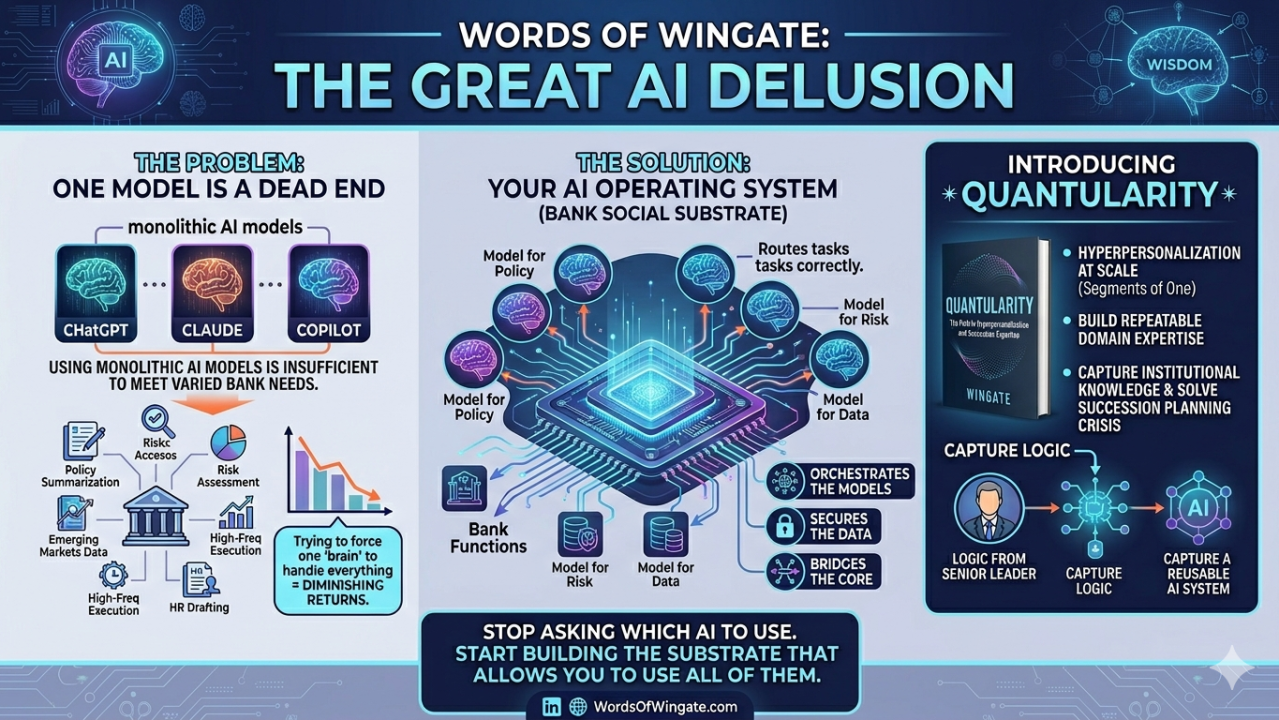
In the high-stakes world of financial institutions, there is a question I've been asked more than any other over the last year: "Which one should we use? Claude, Copilot, or ChatGPT?"
It's a natural question. We are conditioned to look for the "winner" — the one software-as-a-service (SaaS) platform that will sit on our desktops and solve our problems. But after four years of deep-diving into the trenches of artificial intelligence — testing, breaking, and deploying 20 to 30 different models — I can tell you with absolute certainty:
The answer is never just one of them.
The World Bank Lesson: One Model is a Dead End
This isn't just theory. I saw this play out on a global stage back in 2025 at the Google conference. I was working with the World Bank, and they were grappling with a problem that is now haunting almost every boardroom.
They had done what everyone else was doing: they picked a flagship model, deployed it, and then sat back and waited for the "transformation." Instead, they found themselves struggling to get the entire organization to find actual value in it.
The reason? One model cannot do everything. By trying to force a single "brain" to handle every task from HR to high finance, they hit a wall of diminishing returns. They weren't failing because of the AI; they were failing because they lacked the infrastructure to let the right model handle the right task.
Entering the Era of Quantularity
This is the core thesis of my book, Quantularity. We are moving past the era of "General AI" and into the era of hyper-personalization.
In the book, I argue that the true value of AI isn't in its ability to write a generic email; it's in its ability to achieve Quantularity — the state where an organization can quantify and scale highly specific, repeatable domain expertise.
When you build a strategy around a single model, you are settling for "General Intelligence." When you build a strategy around a substrate, you are building Institutional Intelligence.
1. Hyper-Personalization at Scale
True Quantularity allows a bank to move from "Customer Segments" to "Segments of One." You aren't just using an LLM to chat; you are using an orchestrated mesh of models to understand the specific financial DNA of a single member, in real-time, across every touchpoint.
2. Capturing the "Ghost in the Machine" (Succession Planning)
The most terrifying risk for any financial institution is the loss of institutional knowledge. In Quantularity, I dive deep into how a properly built substrate can actually solve the Succession Planning crisis. By capturing the decision-making logic, the nuances of risk appetite, and the "gut feel" of your senior leadership into a repeatable domain model, you ensure that the expertise doesn't walk out the door when the executive does. You aren't replacing the person; you are scaling their wisdom.
The Solution: BankSocial Substrate
This leads us to the fundamental shift every financial executive needs to internalize: You don't need an AI app; you need an AI Operating System.
When I talk about the BankSocial Substrate, I'm talking about a foundational layer that sits between your institution and the world of AI models. It acts as the "connective tissue" that:
- Orchestrates the Models: It routes the hard logic to the "heavy" models and the routine tasks to the "light" ones, optimizing your spend and performance in real-time.
- Builds the Moat: It allows you to wrap your unique data and domain expertise — the stuff we talk about in Quantularity — around these models so they speak your language, not Silicon Valley's.
- Secures the Future: It provides the secure pipelines necessary to connect AI logic to your core banking systems without exposing your PII to the public web.
The Words of Wingate Bottom Line
The institutions that win won't be the ones that picked the "best" model this month. They will be the ones that built the best substrate.
If your strategy is tied to a specific model, you will be constantly pivoting and constantly behind. But if you have an operating system that is model-agnostic — a system where you can swap out the "brain" and keep the "training" as soon as a better version becomes available — you become untouchable.
Stop asking which AI you should use. Start building the substrate that allows you to achieve Quantularity.
Is your institution building an AI strategy on a single model, or are you building an operating system that can survive the next ten generations of AI?
Want to talk about this with me?