The Future of Finance Is Not Stablecoins. It Is Orchestration.
Every few months, the market finds a new savior. Cards, ACH, RTP, stablecoins. They're all instruments. The real shift isn't a new rail — it's the intelligence that knows which rail to use, when, and under what controls.
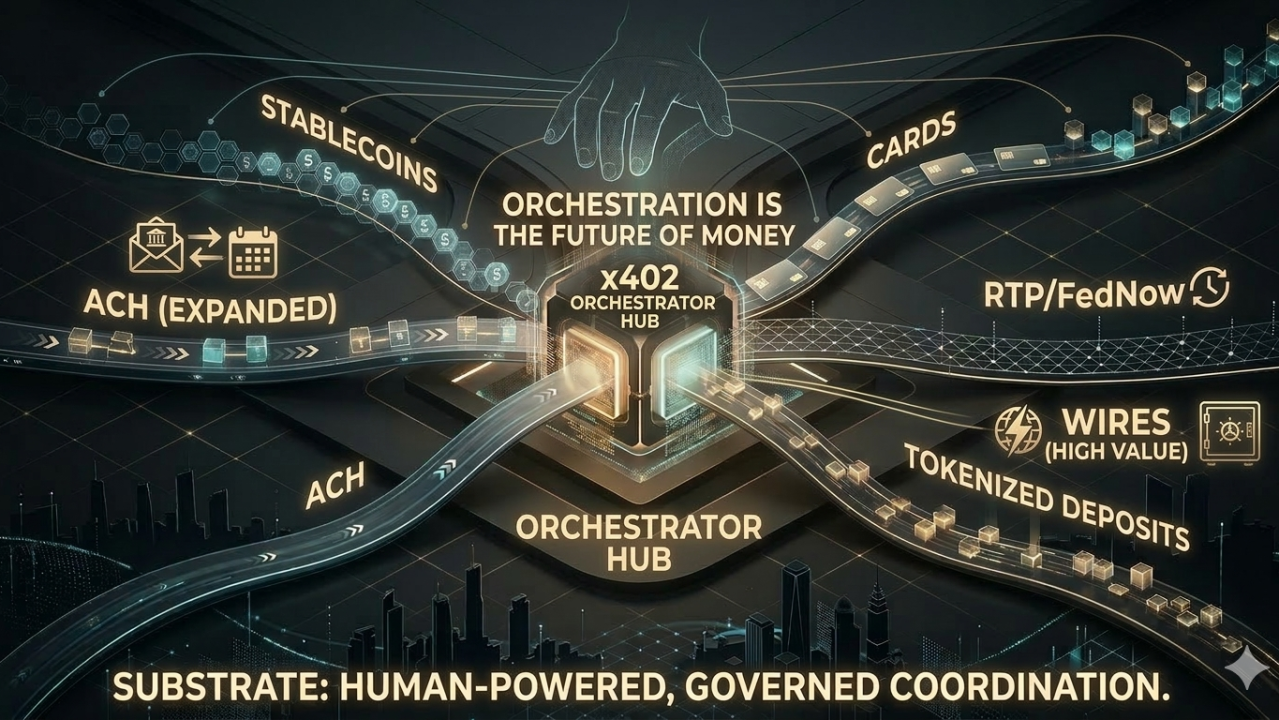
Every few months, the market finds a new savior.
First it was digital wallets. Then embedded finance. Then stablecoins. Now, with launches like agentic cards pushing deeper into the mainstream, the next wave of people are rushing to declare they have found the one rail that will define the future of money movement.
They have not.
For over a year, I have been saying the same thing: if you are looking at stablecoins as the next savior of finance, you are already behind. Not because stablecoins do not matter. They do. They are important. They will absolutely play a meaningful role in what comes next. But they are not the whole future, and mistaking an instrument for the infrastructure is one of the biggest strategic errors the market keeps making.
The future of finance is not stablecoins only. It is not cards only. It is not ACH only, RTP only, FedNow only, or tokenized deposits only. It is not about picking a rail, planting a flag, and calling it innovation.
It is orchestration.
That is the real shift happening right now.
Agents are not going to live inside a single payment ideology. They are not going to operate in a world where one rail wins and everything else disappears. They are going to need to move value across cards, deposit accounts, real-time rails, tokenized money, internal ledgers, and whatever new forms of financial movement emerge from here. In one context, a card may be the right answer. In another, it may be account-to-account. In another, a stablecoin or tokenized settlement asset may create speed, programmability, or interoperability advantages. The future will not be defined by a single tool. It will be defined by the intelligence that knows which tool to use, when to use it, and under what conditions it should be allowed to move.
That is where the real opportunity is.
The real challenge is not creating one more instrument. It is not launching one more rail-specific product and pretending that solves the complexity of modern finance. The real challenge is building the intelligence, controls, permissions, governance, and execution layer that can operate across all of it.
Because that is what finance is becoming: not less complex, but more dynamic. More contextual. More embedded. More multimodal. More dependent on systems that can make decisions across fragmented environments without sacrificing trust, safety, or institutional control.
And that brings us to the point too many people are still missing.
Agents will not act alone.
Anybody building for a future where autonomous agents just run wild moving money has already lost the plot. The future of agentic finance is not autonomous chaos dressed up as innovation. It is governed coordination. Humans will define the permissions. Institutions will define the controls. AI will help determine the context, timing, pathway, and execution. But agents will operate inside human-defined boundaries, institutional guardrails, and approved frameworks of trust.
That distinction matters more than the market is willing to admit.
Because "agentic finance" without governance is just reckless automation with a new label. And automation without context is exactly how institutions lose control, lose trust, and expose themselves to operational, regulatory, and reputational risk. Real financial infrastructure has to do more than move fast. It has to move intelligently. It has to know what is permitted, what is optimal, what is secure, and what aligns with the intent of the institution and the human behind the interaction.
That is why we built BankSocial Substrate.
Substrate is Human Powered AI for Agentic Value Orchestration across any value stream in finance.
Not hype orchestration. Not trend chasing. Not a wrapper around the latest market obsession. Real value orchestration.
Substrate was built around a simple belief: the future will belong to the platforms that can intelligently coordinate value movement across every approved rail, while keeping humans and institutions firmly in control. That means permissions. That means policy. That means contextual execution. That means security, oversight, and governed intelligence built for regulated environments — not bolted on after the fact.
This is bigger than stablecoins. Bigger than cards. Bigger than any single rail that happens to be having a moment.
What is emerging is a new operating model for value itself.
- A model where agents can act, but not alone.
- A model where humans remain central.
- A model where institutions do not get disintermediated, but empowered.
A model where value can move across the right rail, at the right time, for the right reason, within the right boundaries.
That is the future.
Stablecoins will be part of it. Cards will be part of it. Real-time payment networks will be part of it. New forms of tokenized value will be part of it.
But none of them, alone, are the answer.
The answer is orchestration. And not button presses and 100 links. Seamless, intuitive, orchestration.
And most importantly, that orchestration will not be machine-only. It will be human-powered, institution-governed, and contextually executed across every approved value stream.
It starts now.
Want to talk about this with me?